
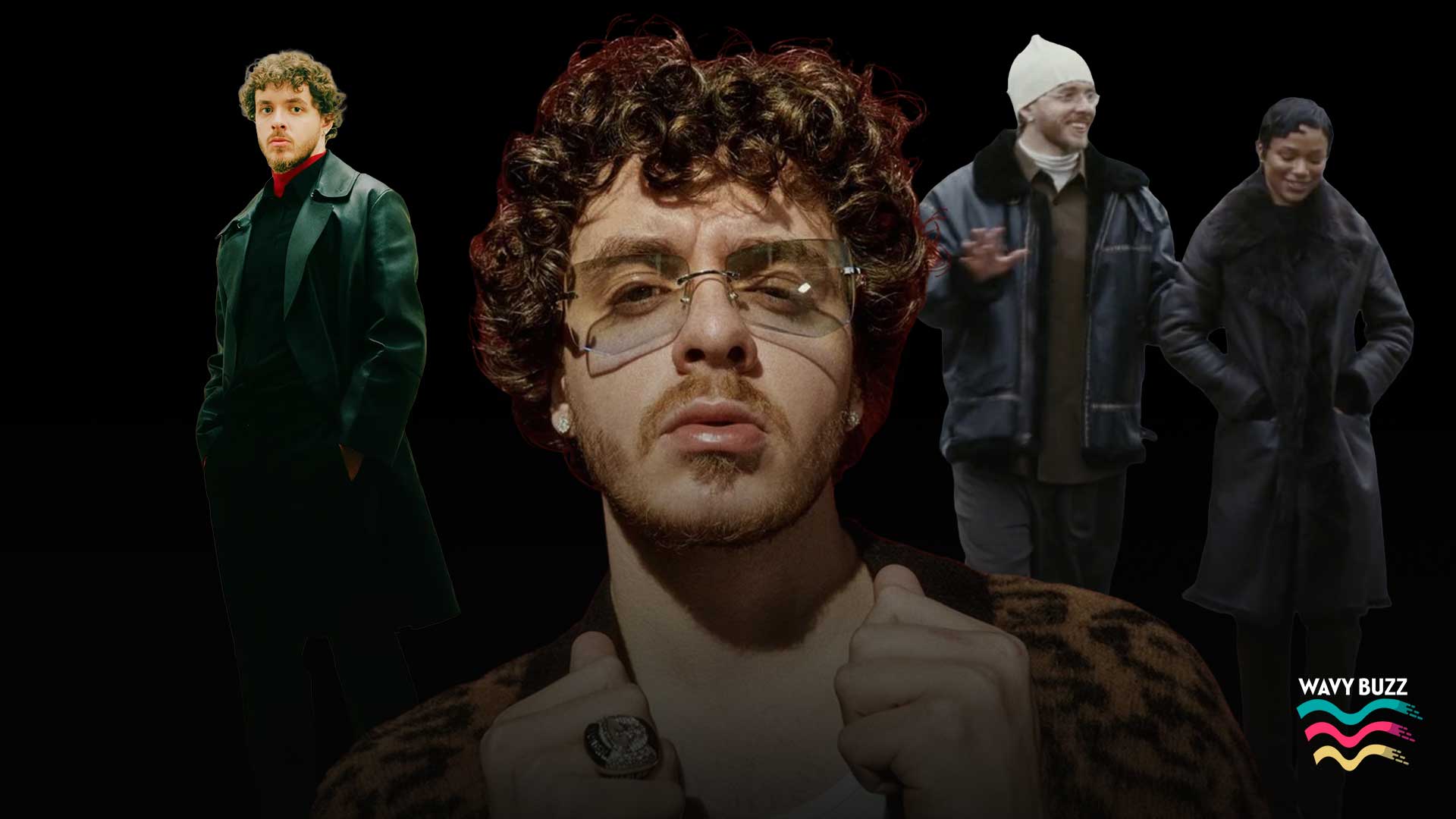
Jack Harlow didn’t lose the audience with Monica. He lost them before they even pressed play.
Released on March 13th, Monica — Harlow’s fourth studio album — is a concise, thirty-minute project that marks a sharp departure from his traditional sound. Known for his charisma and sharp rap delivery on records like What’s Poppin, First Class, and Lovin’ on Me, Harlow has long proven he’s more than a one-hit wonder. But Monica isn’t about proving he can rap — it’s about proving he can evolve.
Like many artists before him, Harlow is attempting to step beyond the confines of being a hitmaker, drawing inspiration from figures like Drake and Kanye West — artists who redefined themselves by pushing into new sonic territories. However, somewhere between the album’s rollout, its nostalgic 90s R&B aesthetic, and the absence of a clear narrative bridge, fans were caught off guard.
What followed wasn’t immediate appreciation — it was confusion, memes, and a wave of cultural commentary that ultimately overshadowed the music itself.
The Pivot Was Right. The Framing Wasn’t.
On paper, Monica makes sense.
Harlow stepping into an R&B-adjacent lane — leaning into melody, intimacy, and softer production — is a natural extension of his persona. The charisma, the charm, the romantic undertones — it’s always been there. This isn’t a reinvention as much as it is a refinement. Not a left turn, but a deeper push into a lane he’s been circling for years.
Even contextually, the move isn’t far-fetched. His earlier work has featured artists like Chris Brown and Bryson Tiller — established R&B heavyweights — signaling a long-standing proximity to the genre. But proximity isn’t the same as immersion. As a solo act, Monica still registered as a left turn, not because the sound was unfamiliar, but because the transition lacked a bridge.
Traditionally, genre expansion is introduced through familiarity. Artists ease audiences into new territory through sampling, interpolation, or strategic collaboration — tools that anchor experimentation in nostalgia. Consider Burna Boy’s Last Last, which borrows from Toni Braxton’s He Wasn’t Man Enough. The record didn’t just cross genres — it connected generations, serving as a sonic time capsule that made the transition feel intuitive rather than abrupt.
Similarly, Tory Lanez built his Chixtape series on this principle: reworking beloved R&B records while often involving the original artists themselves. His remake of T-Pain’s I’m Sprung, reimagined as Jerry Sprunger, resonated not just because of execution, but because of familiarity. The audience wasn’t being asked to adjust — they were being invited in.
Monica takes the opposite approach. There are no interpolative bridges. No gradual shifts. No narrative runway. Instead, the project arrives fully formed in a space listeners hadn’t been prepared to meet Harlow in — a complete transformation without the transitional cues that typically guide audience perception.
And in today’s attention economy, confusion isn’t neutral: it’s a liability.
The Unintentional Narrative
Harlow has earned the right to experiment.
At this stage in his career, creative expansion isn’t just allowed—it’s expected. But experimentation at this level comes with a tradeoff: when you remove collaborators, features, and familiar sonic anchors, you also remove insulation. There’s no one else to distribute the risk. If the audience resists the shift, the weight of that reaction lands entirely on you. And with Monica, that’s exactly what happened.
Aware that he was stepping into unfamiliar territory, Harlow attempted to frame the moment through conversation. In his interview with The New York Times, he positioned this project as part of a broader artistic evolution — one influenced in part by Drake, arguably the modern blueprint for versatility. Harlow’s ambition is similar. Not just to make hits, but to become omnipresent. To be understood not as a moment, but as a range.
A featureless album like Monica reinforces that intention. It’s a statement of self-sufficiency—an attempt to stand alone, without the support of co-signs or genre proxies. In theory, it’s a strong artistic bet. But in practice, the framing unraveled.
One quote — “I got Blacker”— became the focal point of the conversation, distorting the intent behind the project and reframing it through a lens Harlow likely didn’t anticipate. On social media, nuance doesn’t travel. And just like that, the narrative shifted. Almost immediately, Monica became a conversation piece, but not in the way intended.
This is crazy lol pic.twitter.com/fKNqeVZXQe
— Teller Bank$ /🏝️🏝️🏝️/ Marion Wood$ (@Teller_Banks357) March 14, 2026
Clips circulated. Jokes formed. Timelines filled with confusion, irony, and exaggerated takes. The album didn’t trend as a listening experience — it trended as a moment.
Once Monica was framed as unexpected — or worse, unserious — it became increasingly difficult for the music itself to regain control of the conversation. The memes moved faster than the meaning.
Intent, Lost in Translation
With Monica, Jack Harlow didn’t just release an album—he walked into one of Hip-Hop’s most delicate tensions: the gap between intention and perception.
Innovation in rap has always come with risk. Artists who attempt to expand beyond their established image are rarely judged on intent alone. Harlow, in his own way, ran into that same tension because Monica isn’t lacking creatively. Records like Trade Places reveal a softer, more intentional side; however, intent alone doesn’t guarantee reception.
Part of the dissonance lies in Monica’s aesthetic language. The project draws heavily from 90s R&B. At this stage in his career, Harlow hasn’t fully built the bridge to that era. So instead of reading purely as homage, parts of the rollout were interpreted as overreach.
Still, Monica shouldn’t be dismissed. If anything, it’s the kind of project that ages better than how it lands:
- Jack Harlow didn’t miscalculate his creativity
- He miscalculated the timing of belief
- And in a culture where perception moves faster than music, that difference is everything