
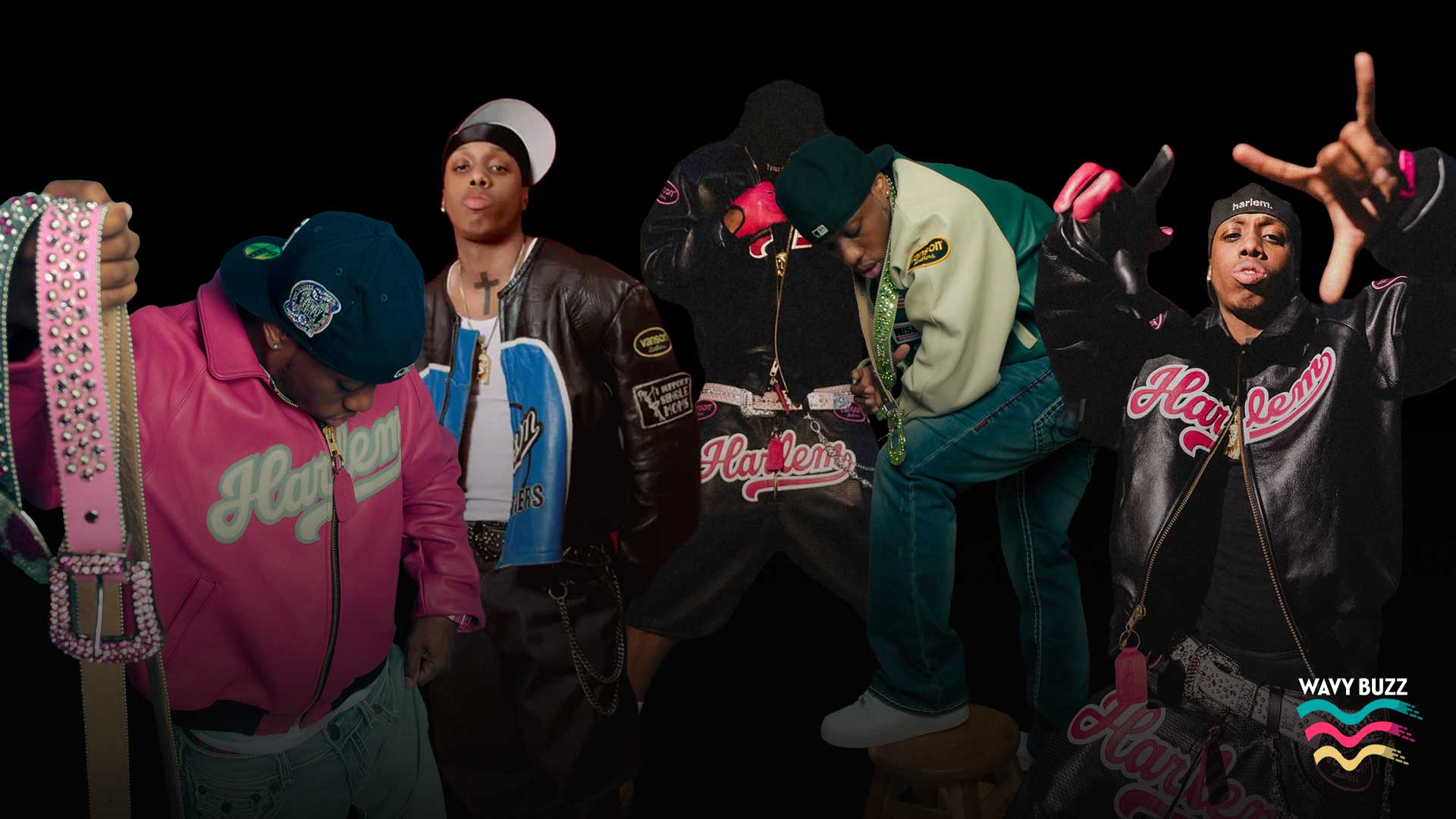
New York City’s relationship with hip-hop has always been exacting. That scrutiny is not incidental; it is earned. As the birthplace of the art form, the city has long treated rap not merely as entertainment, but as a mechanism through which neighborhoods define and distinguish themselves. There are recognizable sonic and cultural signatures tied to each borough — the Bronx’s foundational grit, Brooklyn’s evolving dynamism, Harlem’s particular brand of polish.
Harlem, in particular, has cultivated a reputation that is both slick and aspirational, yet deeply reverent of its own history. It is a place where style is inseparable from substance, where confidence is not performed but assumed. Few artists captured that ethos more distinctly than Max B, whose melodic swagger and unbothered charisma helped redefine what Harlem could sound like in the late 2000s. His influence, often understated in mainstream conversations, reinforced a core truth about the neighborhood: Harlem does not follow waves — it creates them.
To say “I’m from Harlem” is not simply to state geography; it is to invoke a lineage of style, ambition and creative independence that has persisted across eras. That ethos has found expression through artists who embody both elegance and bravado — from the flamboyance of the Diplomats to the global cool of A$AP Rocky and the A$AP Mob.
Today, a new figure is beginning to emerge within that continuum: Fergie Baby.
A Nonlinear Rise
Fergie Baby’s path to music was neither immediate nor inevitable. Born and raised in Harlem, he attended Penn State on a Division III basketball scholarship, earning a degree in criminal justice — a trajectory that suggested stability rather than creative risk. After graduating, he returned to New York and took on administrative work, building a life that, on paper, appeared conventional.
Music, at the time, existed more as a social currency than a professional pursuit. He rapped casually among friends, moved within local circles as a promoter, and remained adjacent to the culture without fully committing to it. That distance began to narrow as dissatisfaction with his career path set in — a familiar tension between obligation and ambition.
His debut single, “Bleachers,” was less a formal arrival than a measured experiment, a way of testing whether his instincts could resonate beyond his immediate environment. The response within Harlem and niche pockets of the city suggested that they could. That early momentum carried into “It’s Neaky,” a reinterpretation of Fantasia’s “When I See You,” which reimagined a familiar R&B record into something distinctly local — lighter in tone, yet culturally precise.
Momentum, Interrupted and Resumed
Released in 2018, Are You Dumb, Vol. 1 formalized that momentum, establishing Fergie Baby as a credible newcomer at the regional level and opening the door to live performances across the boroughs. Yet just as that visibility began to compound, the Covid-19 pandemic disrupted the most critical component of his growth: audience proximity. For an artist whose appeal relied as much on presence as on sound, the pause was consequential.
Still, the underlying momentum proved durable. Three years later, Are You Dumb, Vol. 2 arrived at a moment of cultural reentry, effectively picking up where its predecessor had left off — but now within a reopened city. The project translated into tangible audience connection, with records like “Freak” and “Beneficial” circulating as underground staples among rap listeners. That growing recognition culminated in his first appearance on On The Radar Radio, signaling his transition from local fixture to an artist operating within a broader, if still developing, conversation.
From Local Signal to Cultural Momentum
If Fergie Baby’s rise has a defining characteristic, it is not velocity but accumulation. His ascent has been gradual, built through consistency rather than spectacle. That trajectory continued with the release of Summer League, Vol. 1, a project that further clarified his artistic identity while deepening his connection to Harlem as both subject and setting.
At its center is “Good Day to Be in Harlem,” a record that operates as both celebration and statement of intent. Built on an easy, almost euphoric energy, the song reframes the neighborhood not through struggle, but through pride — emphasizing its beauty, rhythm, and sense of possibility.
The record’s resonance extended beyond local audiences when A$AP Ferg contributed a remix, effectively bridging two generations of Harlem artists. Their collaboration, accompanied by a music video shot within the neighborhood itself, leaned fully into that sense of uplift — presenting Harlem less as backdrop and more as protagonist.
In time, the record evolved into a cult favorite, circulating with a persistence that outpaced traditional promotional cycles. Recognition from outlets such as Billboard signaled a subtle but important shift: Fergie Baby was no longer operating solely within a local context. His interpretation of Harlem had begun to travel.
Choosing a Different Sound
That distinction becomes even more pronounced when placed against the broader landscape of New York rap. In an era increasingly shaped by the immediacy of drill — popularized by artists like Cash Cobain, Bay Swag, and at times A Boogie wit da Hoodie — Fergie Baby has chosen a more deliberate path.
On Summer League, Vol. 1, his reinterpretation of What’s Your Fantasy, reworked as “Fantasy,” functions not simply as homage but as translation — bridging generational gaps through style, cadence, and wit. It reflects a level of playfulness and lyrical awareness that suggests not only technical ability, but a deeper engagement with the genre’s lineage.
That orientation has begun to attract the attention of those who helped define earlier eras. Cam’ron has aligned himself with Fergie Baby through an upcoming remix of “Harlem River Drive,” signaling a passing acknowledgment within Harlem’s evolving lineage.
A Question of Scale
Whether that strategy will translate into mainstream success remains an open question. The contemporary music economy tends to reward scale, and scale often demands compromise — a dilution of specificity in favor of broader accessibility.
And yet, there are moments when the opposite proves true — when an artist’s commitment to a particular place or perspective becomes the very reason their work resonates beyond it.
The Return of the Narrator
If Fergie Baby’s trajectory continues, it will likely be because he has chosen the more demanding path: not merely to participate in New York’s rap scene, but to document Harlem in real time. His music does not attempt to universalize the neighborhood. It insists on its specificity.
In that sense, his emergence is less about competition than it is about restoration.
Harlem has never struggled to produce talent. What it has required, in each generation, is translation — an artist capable of capturing its contradictions, its confidence, and its evolving identity without reducing it.
It is, as it has always been, a search for a narrator.